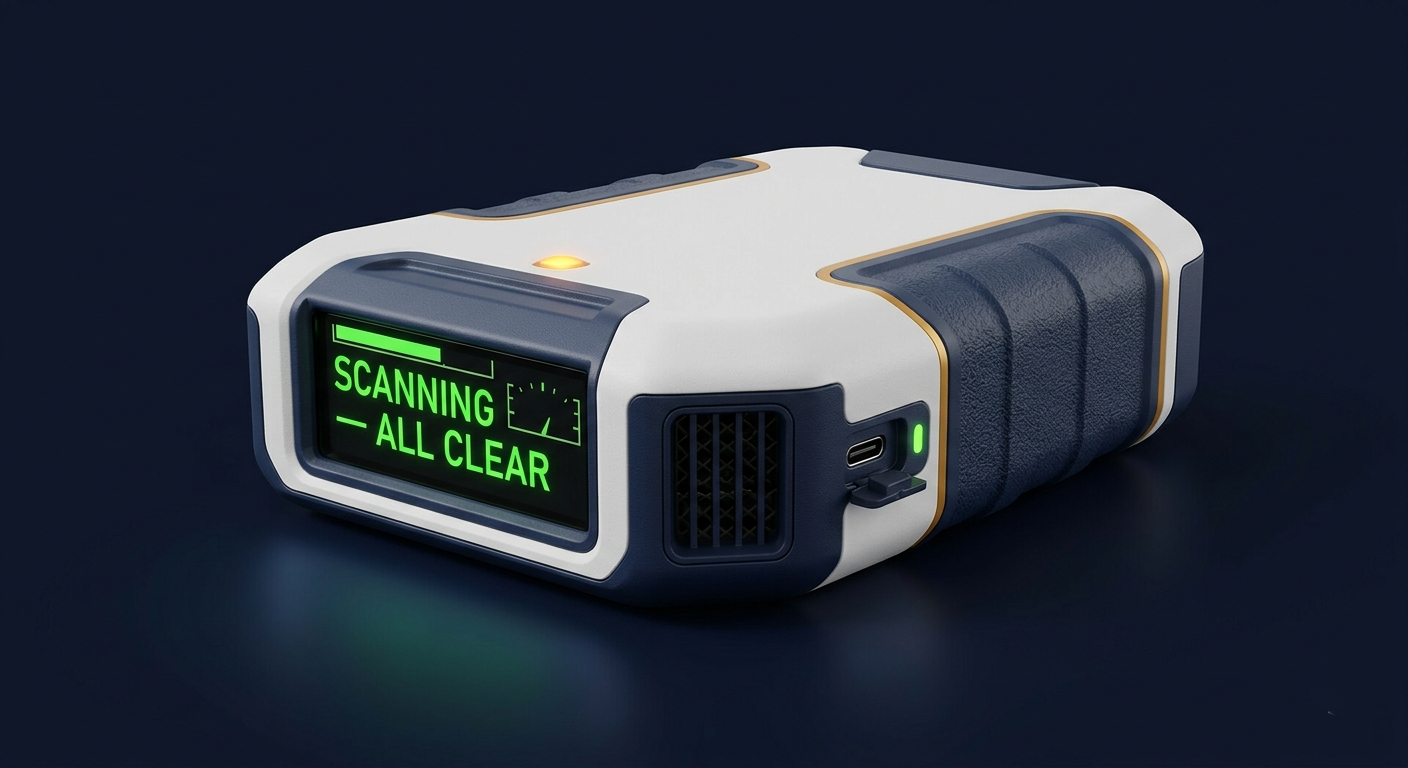
A solid-state, battery-powered multi-threat detector for CWAs, TICs, and explosives, built on AATG's proprietary detection technology with exceptional sensitivity (ppb to sub-ppb, pg to ng range). Seconds-level screening. 120-second on-site confirmation. No carrier gas. No radioactive source. No second instrument.
Proprietary technology. Detection methodology, instrument configuration, signal processing architecture, and AI inference pipeline are IP protected. Full technical specifications, sensitivity data, and system architecture are available to qualified government and industry partners under executed NDA. Request partner access →
Having worked in threat detection for close to 30 years, we understand the limitations operators live with daily. r-Guard™ was designed specifically to close every gap current technology leaves open.
Ion Mobility Spectrometry dominates field CWA detection, but its limits are well documented: poor resolution and peak shifting drive false negatives, charge competition in mixed vapor suppresses target agents, high humidity degrades performance exactly when reliability matters, and the radioactive Ni-63 source adds handling, transport, and disposal constraints.
Most field detectors give a threshold alarm: positive or negative, a compound class at best. They cannot quantify confidence, report concentration, or tell a strong interferent from a genuine threat. In high-stakes scenarios, a wrong answer is as dangerous as no answer.
Deployed detectors only identify what is already in their library. A novel synthetic agent, new precursor, or unknown industrial chemical produces a forced false match or silence. As adversarial chemistry evolves, this gap widens — and adding a substance takes a vendor update cycle measured in months.
Traditional systems are effectively blind while analyzing. Lab-style instruments cannot monitor the air stream while processing a sample; IMS units have maintenance windows where monitoring stops. Against a second release or a moving plume, a 30-second gap can be operationally decisive.
Lab-grade confirmation instruments need compressed carrier gas cylinders, high-vacuum pumps, and significant power. IMS units carry radioactive Ni-63 sources subject to transport restrictions. For dismounted soldiers, UAV payloads, or resource-constrained responders, field confirmation simply does not exist.
When IMS alarms, the operator cannot confirm in the field — verification means a separate lab or vehicle-mounted instrument needing carrier gas, vacuum, and power. Analysis takes 5–15 minutes, during which exposure continues. The gap between fast alarm and confirmed identification has never been closed in one portable instrument.
Built on validated science and engineering — not unsubstantiated claims. The detection principle and methodology underpinning r-Guard™ are grounded in extensive research and engineering development in related fields, including trace vapor detection and probabilistic chemical identification, and in published field reference works co-authored with researchers at Edgewood Chemical Biological Center (ECBC). The proprietary AI inference architecture has been independently validated in a demanding clinical VOC detection application.
Each addresses a documented limitation of current detectors — especially the widely deployed IMS-based systems — and the confirmation gap never closed in a single portable instrument.
Proprietary AI combined with molecular-level identification outputs confidence scores, not binary alarms, and distinguishes target agents from interferents in complex mixtures. Charge competition — the primary IMS failure mode causing false negatives in mixed environments — does not apply to our detection principle.
IMS: high false positive AND false negative riskProprietary detection technology delivers ppb to sub-ppb (pg to ng range) sensitivity in a compact field instrument — maintained in humid, dusty, and chemically complex environments where IMS degrades significantly. Key for high-volatility explosive vapors such as TATP and NG, and precursors including acetone and hydrogen peroxide.
IMS sensitivity degrades with humidity & interferents~10s screening and ~120s full agent confirmation in one handheld unit. Eliminates the confirmation gap that forces operators to choose between fast-but-unreliable and accurate-but-absent. No second instrument. No laboratory. No waiting.
IMS + lab-grade instrument required todayFor compounds in no library, r-Guard™ performs molecular signature analysis: characteristic features map to functional groups (organophosphate, C=O carbonyl, C-H, halide class), and volatility behaviour further resolves components. Together these let the AI infer probable chemical class and — often — a reasoned estimate of the specific compound, without a library match.
Current detectors: unknown = silence or forced false matchSome IMS systems report agent names, but with far higher false identification rates in complex environments where charge competition corrupts the result. r-Guard™ identifies individual molecules with high precision, providing the specific agent name alongside a calibrated confidence score and a full inference chain the operator can evaluate.
IMS: class-level or unreliable specific IDNo Ni-63 source — no radioactive handling, transport restrictions, or disposal. No compressed gas cylinders. No high-vacuum pump. One replaceable air-scrubbing cartridge, used to clean the system when needed, is the only consumable — lasting hundreds of operational hours.
IMS: Ni-63 source. Lab-grade: carrier gas + vacuumNew AI models and threat libraries are pushed wirelessly to all deployed devices simultaneously. As novel agents, precursors, and emerging threats appear, the entire sensor fleet updates at software speed — no hardware recalls, no field modifications, no vendor cycle measured in months.
Current systems: vendor hardware update requiredTwo adaptive modes run in concert — continuous monitoring transitions seamlessly to active high-resolution confirmation without user intervention.
Ambient air flows continuously through the detection module. The AI monitors the real-time stream at low power, establishing a dynamic baseline and alarming fast on high-concentration threats.
Triggered automatically when the AI detects a statistically significant deviation, or manually by the operator. The AI inference engine runs full multi-variate analysis, with a result in ~120 seconds.
Context-aware sampling. When the AI detects a slight deviation — before any agent is identified — the system silently ramps the pump, increases integration time, and primes for confirmation. This "pre-discovery" state maximises data collection during the critical window between "something is present" and "agent confirmed," without triggering a false alarm. Confirmation is only declared at high statistical confidence. The approach roughly doubles effective battery life versus continuous high-power operation, while ensuring no trace event is missed.
Designed from the ground up for field deployment — not adapted from laboratory equipment. Every component choice reduces size, weight, power, and logistics burden.
The sensor assembly is pre-aligned in a kinematic-mount sleeve. A contaminated or degraded module swaps in under 30 seconds with no realignment. On-cartridge memory stores the sensor baseline for instant AI recalibration.
Two independent sensor paths operated via proprietary switching architecture. One path monitors continuously while the other purges — no detection gaps during cleaning cycles, critical in dynamic threat environments.
A compact solid-state trap collects and concentrates the sample stream continuously in the background. Controlled release resolves components by volatility class, and the integrated heater doubles as the purge cycle.
A replaceable cartridge — HEPA filter, molecular sieve desiccant, and activated carbon — provides clean dry air for purge cycles, eliminating compressed gas cylinders entirely. Replacement interval: hundreds of operating hours.
A three-state display reflects real-time AI confidence. Green: clean baseline. Yellow: suspicious deviation, actively investigating. Red: agent confirmed with identity and confidence score. Manual override enables operator-controlled thresholds.
An on-board NPU provides full offline capability for life-safety alarming. Optional Bluetooth/Wi-Fi bridge for data logging, remote monitoring, and cloud forensic library access. No network dependency for core function.
For applications demanding the highest identification confidence — forensic documentation, post-incident analysis, or laboratory use — r-Guard™ accepts an optional add-on module that raises the same device to laboratory-grade analytical performance, without replacing the core sensor and without adding compressed carrier gas requirements. The AI layer continues to operate alongside it, combining both for maximum confidence and legal-grade verification.
Current portable detectors force a choice between speed and specificity. r-Guard™ eliminates that trade-off.
| Criterion | IMSField standard — JCAD, M4A1 | Lab-grade systemsConfirmation instruments | PIDFirst responder survey | r-Guard™ (AATG) |
|---|---|---|---|---|
| Screening speed | <30 sec | 5–15 min | <5 sec | ~10 sec continuous |
| Confirmation speed | Not applicable | 5–15 min | Not applicable | ~120 sec, in field |
| Molecular specificity | Moderate — drift time only | High | None — class survey only | High — field grade |
| False positive risk | High — perfume, sanitizer, fuels | Low | Very high — non-specific | Low — AI-filtered |
| False negative risk | High — charge competition in mixtures | Low | High — below threshold | Low — high sensitivity + AI |
| Mixture analysis | No — charge suppression | Yes | No | Multi-layer digital deconvolution |
| Carrier gas / consumables | None | Cylinders, columns, calibration gas | None | Air cartridge only — no gas |
| Probabilistic output | Binary alarm only | Binary result only | Concentration reading only | Full confidence score + chain |
| Unknown compound | False alarm or miss | Library mismatch flagged | Uncharacterised | Functional group + volatility class |
| Continuous monitoring | Yes | No — batch mode | Yes | Zero blind spot — dual path |
| Weight | 2–15 lbs | 20–50 lbs | <3 lbs | <5 lbs |
| Field deployable | Yes — handheld | Lab / vehicle only | Yes — handheld | Handheld / UAV / fixed site |
| Updateable library | Limited — vendor update | Limited — vendor update | Not applicable | OTA wireless update |
IMS = Ion Mobility Spectrometry, the most widely deployed field CWA detector technology. PID = Photoionization Detector. Development-stage platform — r-Guard™ performance figures are projections based on component specifications. Field validation studies are planned.
The same core hardware serves defense, security, and industrial applications. Library and configuration updates tailor the device to each domain without hardware modification.
Real-time CWA detection for soldiers, medics, and CBRNE specialists. The wearable/handheld form factor eliminates the compressed-gas logistics burden that currently limits frontline deployment, with continuous monitoring and no detection gap during confirmation cycles.
Sub-5 lb weight and a tank-free design make r-Guard™ an ideal chemical-reconnaissance payload for UAVs and unmanned ground vehicles — enabling standoff CWA detection and area mapping without risking personnel. Edge NPU provides full autonomous operation without a ground station.
Rapid screen-then-confirm capability for civil defense teams at transit hubs, chemical incidents, and disaster sites. Probabilistic output guides triage without false alarms.
Continuous monitoring at airports, border crossings, government facilities, and chemical plants. Ambient air-scrubbing enables permanent installation without gas supply infrastructure.
Detection of Toxic Industrial Chemicals in manufacturing environments. Same hardware as the defense application — a library update targets industrial hazards, with no hardware modification.
High-confidence molecular identification with full inference chain output for forensic documentation. Cloud forensic mode accesses an extended library of 100,000+ compounds.
Library selection reconfigures r-Guard™ for each threat type. The same core hardware and collection cartridge serves all configurations — a software library selection is all that changes.
| Configuration | Target threats | Key capability | Primary users |
|---|---|---|---|
| CWA Screen STANDARD |
Nerve agents (G, V series), blister agents (HD, L), blood agents, choking agents | Continuous ~10s screening with AI agent identification and confidence scoring. Identifies the specific agent, not just a compound class. On-site confirmation in ~120s, no second instrument. | Military CBRNE, first responders, fixed-site monitoring |
| CWA + Forensic Confirm OPTIONAL ADD-ON |
Full CWA panel + forensic-grade confirmation | The optional confirmation module combined with AI deconvolution approaches laboratory-level performance — the AI layer operates alongside it for maximum confidence. For legal-grade documentation and post-incident analysis. | Forensic teams, post-incident analysis, legal-grade evidence |
| TIC Monitor LIBRARY UPDATE |
Toxic industrial chemicals: ammonia, chlorine, phosgene, HCN, and 100+ industrial hazards | Continuous area monitoring for industrial accident, spill, or deliberate release. Same hardware — different library selection, no hardware modification required. | Industrial safety, occupational health, disaster response, plant monitoring |
| Explosive Trace LIBRARY UPDATE |
TATP, NG, RDX, PETN, HMTD vapor; TATP precursors (acetone, hydrogen peroxide) | High-volatility explosive compounds produce detectable vapor signatures at ppb levels. Acetone and peroxide detection provides early TATP precursor warning — addressing a known gap in current airport and checkpoint IMS deployments. | Military EOD, border security, checkpoint screening, aviation security |
All configurations use the same core hardware and collection cartridge. Switching between CWA, TIC, and Explosive modes requires only a library selection — no hardware or cartridge change. CWA + Forensic Confirm requires the optional add-on module. Development-stage platform — field validation studies planned.
r-Guard™ overcomes the sensitivity and selectivity limits of conventional field detectors through a proprietary multi-layer approach — each layer solving one specific failure mode. What the platform delivers is below; how it is built is IP protected.
Our proprietary detection technology achieves sensitivity conventional portable detectors cannot match — in a compact field instrument.
Compounds are collected in parallel with continuous monitoring, then released in a controlled sequence — resolving interferents from threat agents before identification.
A hybrid AI engine performs real-time analysis: a fast anomaly model watches continuously, and a full inference engine identifies agents during confirmation.
Detection methodology, instrument configuration, and AI inference pipeline are IP protected. Full technical architecture is available to qualified partners under executed NDA.
r-Guard™ is designed as a long-term platform. New capabilities arrive through cartridge, library, and accessory updates — no hardware replacement for the base unit.
An accessory accepts wipe samples from surfaces, feeding vapor directly into the r-Guard™ module. Extends the platform from air monitoring to forensic surface analysis for CWA residues, explosive transfer, and industrial spills — no additional core hardware.
TATP and precursors (acetone, hydrogen peroxide) and NG are high-volatility compounds within r-Guard™ detection range, with precursors serving as early indicators. Delivered as an OTA software update — no hardware change.
Expanded coverage of 200+ toxic industrial chemicals across ammonia, chlorine, phosgene, HCN, and solvent classes. Supports fixed-site and mobile monitoring for plant incidents, rail hazmat, and environmental events. OTA update only.
The same core sensor scaled to a benchtop instrument with the optional confirmation module — approaching laboratory-grade performance for forensic, pharmaceutical validation, and advanced field laboratory use. Bridges field and lab in one platform family.
Fentanyl and novel synthetic opioid analogs at ppb levels — a critical officer-safety and border-interdiction need. AI functional-group inference handles novel analogs even without a library match. Same hardware; narcotics cartridge and OTA library update.
The vapor detection platform extends to environmental compliance and pharmaceutical cleaning validation — detecting residual API and solvent contamination. Aligns with AATG's r-Pharm™ platform.
The same proprietary detection and AI inference architecture already powers BreathDX™, our breath-based cancer diagnostic system for lung and breast cancer. VOCs exhaled by patients are detected and analysed using the same proprietary multi-layer methodology — cross-domain validation that is the strongest evidence the r-Guard™ platform science is real.
Core detection methodology and AI architecture are validated. Investment now accelerates hardware integration and field demonstration.
Proprietary detection methodology, sample preparation strategy, and hybrid AI inference architecture fully designed and analytically validated. The AI engine is proven in a cross-domain VOC detection application (BreathDX). The underlying detection science is documented in published field reference works including Detection Technologies for Chemical Warfare Agents and Toxic Vapors (CRC Press, co-authored with ECBC researchers) and Field Detection Technologies for Explosives (International Labmate).
Active development of an integrated hardware prototype combining the proprietary sensor assembly, solid-state concentrator, dual-path switching architecture, and embedded AI electronics into the target 10×10×10 cm form factor. Component-level testing ongoing. Target TRL 4–5 upon prototype completion.
Laboratory CWA surrogate testing, followed by controlled field demonstration with CBRNE evaluation partners. SBIR/STTR applications and CWMD/MCDC consortium integration. Commercial pathway: defense prime partnerships and industrial safety licensing.
30+ years in field threat detection, trace chemical sensing, and defense instrument development. Author of CRC Press and International Labmate field reference works on CWA and explosives detection, co-authored with ECBC researchers.
Author of Detection Technologies for Chemical Warfare Agents and Toxic Vapors (CRC Press) and Field Detection Technologies for Explosives (International Labmate). Proprietary AI inference architecture independently validated in a clinical VOC application.
Detection methodology, instrument configuration, and AI inference pipeline are IP protected. SBIR/STTR applications in preparation. CWMD and MCDC consortium engagement planned.
We welcome inquiries from defense and security partners, government program officers, UAV/UGV platform integrators, and potential co-founders with detection instrument or medical device hardware backgrounds.
Send a message →Partner & government access. Full technical specifications, sensitivity data, instrument architecture details, and AI methodology documentation are available to qualified government program offices, defense prime contractors, and investment partners under a standard NDA. Note your NDA request when you contact us.