Proprietary Technology · IP Protected
NJ CSIT Supported

Breath-Based
Cancer Detection

🫁 Lung Cancer 🎗 Breast Cancer + Multi-Disease Platform

A complete point-of-care system — from a handheld breath sampler to a proprietary optical analyzer to an AI risk report — delivered in under 15 minutes. No needles. No radiation. No specialist required.
#1
Cancer killer worldwide — lung cancer
85%
Diagnosed at different stages when options are limited
15 min
From breath sample to probability score
2+
Cancers detected — same device, software only
⚠ Proprietary Technology — Specific biomarker identities, detection methodology, and AI inference pipeline are IP-protected. Full panel details available to qualified collaborators and licensees under NDA.
Actively seeking investment and strategic partnerships. Hardware instrument + disposable consumable revenue model. Target market: $11B+ breast cancer diagnostics & $3B+ lung cancer screening globally by 2030. NJ CSIT funded. SBIR Phase I complete. FDA 510(k) pathway planned.
💰 Investment 🤝 Co-founder / Partnership 🏛 SBIR / STTR 🔬 Clinical Research
The Problem

Current screening methods
leave too many people behind.

Existing tools — imaging, lab-based breath analysis — each carry barriers that reduce access, accuracy, or both. BreathDX was designed specifically to address every one of them.

🔍
Imaging detects tumors — not early risk

CT scans and mammograms detect a physical tumor that already exists — meaning cancer is often found only when it has grown large enough to see. 85% of lung cancers are diagnosed at late stage, when survival rates drop dramatically.

BreathDX detects metabolic VOC changes that precede visible tumor formation — enabling earlier risk stratification.
⚗️
Breath samples degrade before analysis

Traditional breath collection uses polymer bags (Tedlar®) that suffer from VOC adsorption, permeation, and off-gassing — meaning the sample you analyze is not the sample you collected. Cold-chain requirements add logistics cost and failure points.

BreathDX traps VOCs on a solid sorbent at collection — samples are stable, transportable without refrigeration, and fully recovered at analysis.
🏗️
Lab-based instruments are impractical

Gold-standard VOC analysis (GC-MS) requires large, expensive, lab-bound equipment operated by trained chemists — ruling out point-of-care use. eNose platforms sacrifice molecular specificity. Neither is deployable in a community clinic or mobile unit.

BreathDX Analyzer is ~15 lbs, sits on a desk, and requires no specialist — bringing lab-grade sensitivity to any clinical setting.
📉
eNose and bag-based systems lack accuracy

Electronic nose (eNose) devices detect broad VOC patterns with no molecular specificity — prone to interference from diet, environment, and confounders. Reported sensitivity/specificity often falls at 70–80%, insufficient for clinical decision-making.

BreathDX identifies individual molecules with molecular-level precision and AI pattern recognition — targeting >90% classification accuracy.
🌍
Screening doesn't reach those who need it most

Mammography and CT are centralized, expensive, and uncomfortable — creating barriers for rural populations, minority communities, and those with religious or cultural hesitancy about physical examination. The result: delayed diagnoses and worse outcomes.

BreathDX is portable, non-invasive, and culturally neutral — breath collection requires no physical examination, making it acceptable across diverse communities.
💸
High cost limits repeat screening

At $100–$250 per mammogram and $200–$500+ for CT, repeat annual screening is a significant financial burden — especially for uninsured or underinsured patients. Cost is consistently cited as a top reason for skipping recommended screening.

BreathDX targets a fraction of current screening costs — making frequent, accessible repeat screening economically viable for clinics and patients alike.
The Workflow

Collect. Analyze. Report.
Under 15 minutes.

A fully integrated point-of-care workflow — from breath collection to clinical probability score — in any clinical setting, no specialist required.

🫁
1
~1 min

Patient Breathes Into Sampler

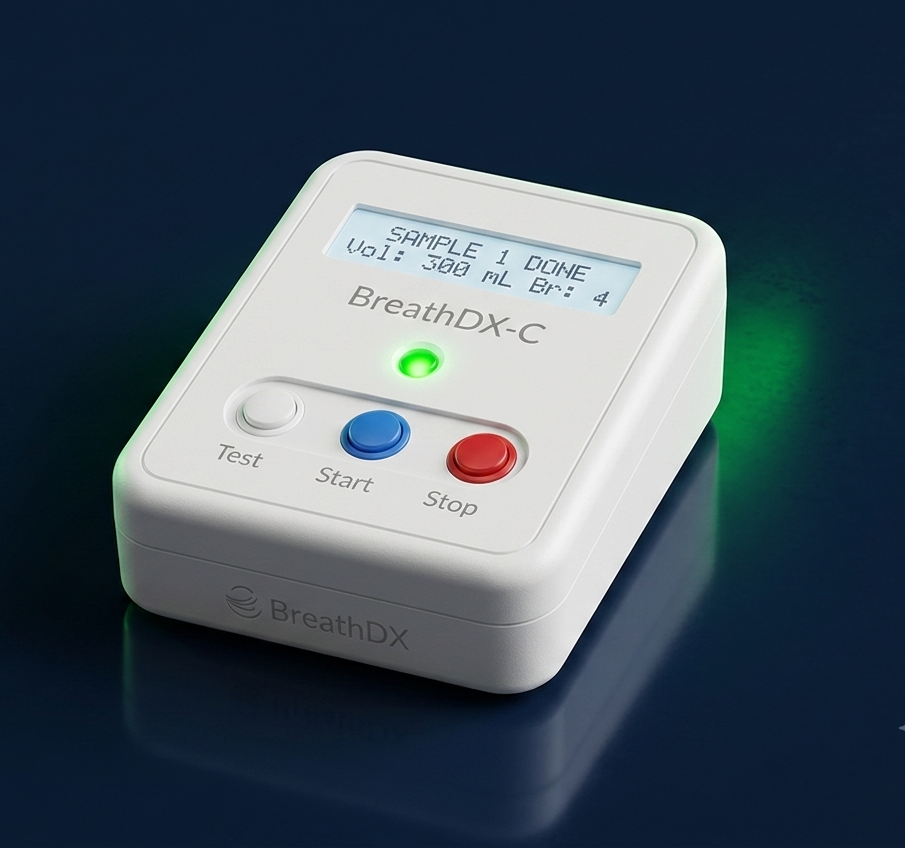
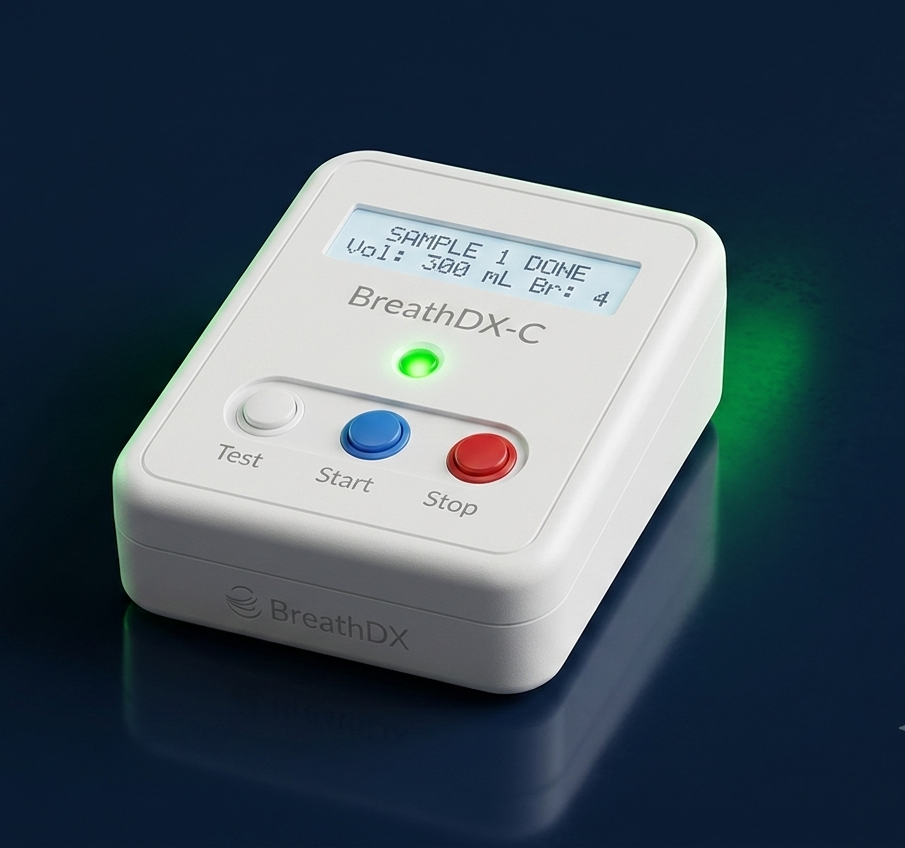
A handheld sampler captures multiple breaths to collect enough VOCs for accurate diagnosis. Disposable mouthpiece. No prep, no discomfort.

⚗️
2
5–12 min

Instrument Identifies VOCs

The collected sample is loaded into our compact analyzer (~15 lbs) and the target VOCs are identified and quantified at sub-ppb sensitivity.

🧠
3
~2 min

AI Computes Risk Score

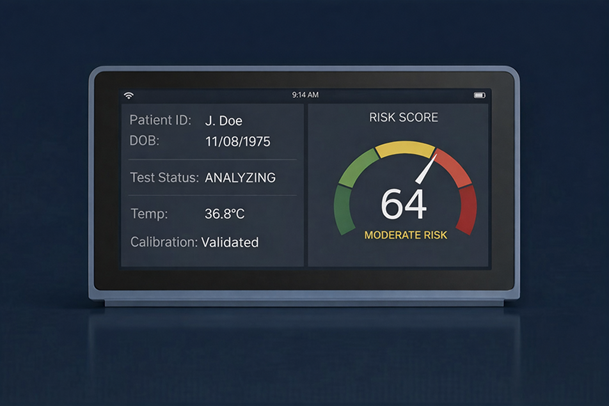
The BreathDX AI engine analyzes the VOC panel — incorporating patient demographics and clinical risk factors — to produce a calibrated cancer probability.

📋
4
~15 min total

Clinician Acts

A clear probability score with supporting biomarker evidence helps the clinician decide: reassure, monitor, or refer for imaging — immediately, at the point of care.

The Complete System

Three components.
One integrated solution.

BreathDX is not just software — it is a complete hardware-to-report system, purpose-built for point-of-care cancer screening.

Handheld Breath Sampler
Component 1

Handheld Breath Sampler

Battery-powered for ease of use, collecting multiple breaths. VOCs are pre-concentrated and sealed for transport, storage, or on-site analysis.
Collects multiple breaths for sufficient VOC volume
Disposable mouthpiece
Sample collectable off-site, transportable
No cold chain required
BreathDX Analyzer
Component 2

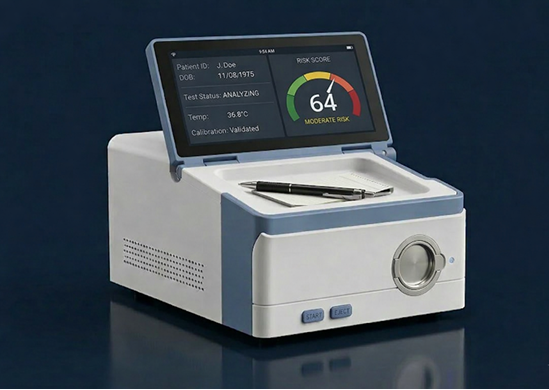
BreathDX Analyzer

A compact desktop instrument (~15 lbs) integrating separation and proprietary optical detection — achieving the high sensitivities needed to identify cancer VOCs. Two operating modes: Screening (~5 min) for rapid triage and Confirmation (~10 min) for high-resolution analysis.

≤1 ppb
Detection sensitivity
~15 lbs
Portable footprint
5–15 min
Full analysis cycle
>90%
Classification accuracy
BreathDX AI Platform
Component 3

BreathDX AI Platform

Software that receives VOC measurements and computes a calibrated cancer risk score — incorporating patient demographics, clinical risk factors, and a proprietary database built from hundreds of peer-reviewed studies.

Lung Cancer & Breast Cancer, same device
Clinician-ready probability report
Evidence-graded biomarker breakdown
Expandable to new cancer types via software
💡
INVESTOR NOTE — Revenue Model
Hardware instrument sale to clinics + recurring disposable consumable revenue (sorption tubes, mouthpieces) per test — a proven razor-and-blade model. Test cost is a fraction of mammography ($100–$250) or low-dose CT ($200–$500+), enabling broad adoption and high-volume throughput.
Who Is BreathDX For

You don't have to wonder
if you should be screened.

BreathDX gives clinicians a fast, affordable answer for the patients most at risk — the people who need screening most but are least likely to get it.

🫁

Lung Cancer Screening

Who should ask their doctor about BreathDX
Smokers & ex-smokers, age 50+
Highest-risk group — 85% of lung cancer cases linked to smoking history
Occupational exposure groups
Miners, construction workers, factory workers, asbestos exposure history
COPD patients & LDCT candidates
Eligible for low-dose CT but seeking a non-radiation first-line screen
Family history of lung cancer
Non-smokers with genetic or familial risk factors
🎗️

Breast Cancer Screening

Who benefits most from a mammography alternative
Women age 40+ for routine screening
Including those avoiding mammography due to pain, anxiety, access barriers, or religious and cultural considerations around physical examination
Dense breast tissue
Mammography has reduced sensitivity — up to 40% of women have dense tissue
BRCA gene carriers
High-risk individuals needing more frequent, less burdensome monitoring
Underserved & rural communities
40% higher mortality in Black women — portable BreathDX reaches where mammography cannot
Where It's Deployed

Who & Where BreathDX Is Used

🏥
Community & Primary Care Clinics
First-line screening without specialist referral. Fits on a desk. Billable at point of care.
🚐
Mobile Health Units & Rural Hospitals
Portable system deploys in underserved areas. No fixed infrastructure needed.
👩‍⚕️
OB-GYN & Women's Health
Breast cancer screen at the annual visit — no separate mammography appointment needed.
🏭
Occupational Health & Research
High-risk worker screening programs, clinical research, pharma biomarker studies.
Competitive Advantage

Why BreathDX outperforms
existing screening methods

Current tools are expensive, invasive, slow, or inaccessible to primary care. Our platform closes every gap simultaneously.

Criterion Low-Dose CT Bronchoscopy / Biopsy Blood-Based Tests Other Breath Methods ⚡ BreathDX (AATG)
InvasivenessNon-invasiveHighly invasiveBlood draw requiredNon-invasiveExhaled breath only
RadiationYes — ionisingMinimal (fluoroscopy)NoneNoneZero radiation
Time to ResultDays to weeksDays to weeksHours to daysHours — varies~15 min, point-of-care
Cost per Test$200–$500+$1,500–$8,000+$100–$400Often research-onlyFraction of mammography or CT cost
Primary Care ReadySpecialist facilityHospital only~Lab infrastructureResearch settingsAny clinical setting
Multi-DiseaseSingle modalitySingle target site~Separate tests neededSingle-disease typicalLC + BC + expandable SW
AI Probability ScoreRadiologist readsPathologist reads~Positive / negative only~Limited AI integrationAI posterior + report
Patient ComfortAcceptablePoor — sedation neededMinor discomfortHighBreath only — no prep
IP ProtectedEstablished methodsEstablished methodsCompetitive landscapePublication-stageFull system IP filed

* R&D-stage platform. Cost and performance figures are projections based on published literature. Clinical validation studies are planned.

The Science

Grounded in large scale research.
Powered by Advanced AI inference.

🔬 Your Breath Has Clues

When cancer cells grow, they alter cellular metabolism — generating Volatile Organic Compounds (VOCs) that enter the bloodstream and are exhaled. Our proprietary system detects a validated panel across multiple compound classes:

Biomarker A* ↑ Biomarker B* ↑ Biomarker C* ↑ Biomarker D* ↑ Biomarker E* ↑ Biomarker F* ↓ Biomarker G* ↓ Biomarker H* ↑

* Specific biomarker identities are proprietary. Full panel available to qualified collaborators under NDA.

🧠 The Advanced AI Inference Engine

Our AI model uses proprietary AI inference to combine multiple factor measurements into a single calibrated probability estimate — exactly as a physician combines test results.

  1. 1
    Pre-test ProbabilityPatient demographics and clinical risk factors establish a prior probability before any measurement.
  2. 2
    Likelihood Ratio LookupEach measured biomarker is assigned an Weight of evidence (WoE) derived from large scale researches
  3. 3
    Correlation AdjustmentCorrelated biomarkers are post precessed for accurate prediction.
  4. 4
    Post-test ProbabilityA clinically interpretable probability score with a supporting evidence report.
Biomarker Architecture

The Biomarker Knowledge Network

Each disease links to proprietary biomarker panels through a graph database extracted from large scale research. Click a filter or hover a node to explore.

Hover a node to explore connections
Use the filters above to highlight Lung Cancer or Breast Cancer biomarker pathways.
Live Demonstration

See the AI Engine at Work

Select clinical risk factors and adjust biomarker panel readings. Watch the AI model probability update in real time. Biomarker identities are anonymised (IP protected).

Patient Profile & Biomarker Input
Target Disease
⚠ Male patient with Breast Cancer model — background risk ~100× lower than female. VOC reference data is predominantly from female populations.
Biomarker Panel Readings
⚠ Biomarker panel identities are proprietary and IP-protected. Chemical classes shown for demonstration only. Full panel methodology available under NDA.
AI Probability Output
Select inputs
Adjust inputs to calculate risk
Signal Breakdown
Inference Chain
Pre-test probability
Raw combined LR
Adjusted score (×0.72 corr.)
Post-test probability
R&D demonstration only · Anonymised biomarker data · Not for clinical use
Platform Extensibility

One device. Many diseases.
No hardware changes required.

New conditions are added by updating the biomarker database and AI model — a software update deployable remotely to all devices simultaneously.

Lead Application

🫁 Lung Cancer

Primary development focus. Multi-panel biomarker system with advanced AI model. Database built from large scale researches. Full Weight of evidence (WoE) table computed and validated.

235K
New US cases/year
10+
Source studies
Model validated
Lead application

🎗 Breast Cancer

Second application in primary development focus. Separate database and Weight of evidence (WoE) established. Differential profiling built — distinguishes lung cancer vs breast cancer biomarker patterns.

300K
New US cases/year
Differential model
DB extracted
💨

COPD & Respiratory

Biomarker profiles differ significantly between COPD, asthma, and healthy — enabling differential respiratory diagnosis from a single sample.

🩺

Liver Disease

Hepatic dysfunction produces distinct breath signatures. Multi-disease graph architecture supports simultaneous multi-condition screening.

🩸

Diabetes & Metabolic

Proprietary metabolic breath markers are well-established indicators of glycemic state — enabling non-invasive glucose monitoring.

🫘

Kidney Disease

Breath biomarkers elevated in renal failure enable early detection through low-cost population screening — no blood draw required.

Clinical Impact & Market

A massive unmet need.
A proven market opportunity.

235K
New Lung Cancer Cases/Year (U.S.)
More deaths than the next three cancers combined
$25B+
Global LC Diagnostics Market by 2030
Driven by rising incidence and demand for point-of-care testing
50M+
High-Risk Americans Eligible for Annual Screening
Current/former heavy smokers aged 50–80 — largely unserved
<5%
Currently Receiving Recommended Screening
A practical breath test could save tens of thousands of lives annually
Investment Stage

Where your investment goes

The AI diagnostic model is fully built and validated. Investment now accelerates the hardware and clinical pathway that brings it to market.

Complete — No investment required
AI Diagnostic Model — Fully Developed
A working multi-disease AI engine for Lung Cancer and Breast Cancer has been fully developed, tested, and validated against large-scale published research. The software is deployment-ready and expandable to additional diseases via model updates alone — no hardware changes needed. Try the live demo on this page.
AI Model CompleteLung CancerBreast CancerMulti-Disease Ready
Current — Active investment stage
Advanced VOC Detection Hardware
We are developing a proprietary optical detection platform for ultra-trace VOC detection — the sensor hardware that will power the breath diagnostic system. This same core technology underpins our broader detection portfolio, including the r-Trace™ explosive detector, r-CWA™ chemical warfare agent detector, and r-Pharm™ pharmaceutical cleaning validator. Investment at this stage funds hardware prototyping, IP consolidation, and SBIR/STTR grant applications (NIAID/NHLBI).
Hardware PrototypingOptical DetectionSBIR/STTRMulti-Application Platform
Next
Clinical Validation & Commercialisation
First-in-human prospective clinical study pairing the completed AI model with the validated hardware platform. Regulatory pathway initiation (FDA 510(k) / De Novo) and commercial launch targeting primary care and oncology screening settings.
Clinical StudyFDA PathwayCommercial Launch
Additional Platforms

Advanced Detection Technologies

AATG's core expertise in advanced analytical instrumentation extends to security, pharmaceutical, and defense detection systems.

Security · Detection

r-Trace™

A revolutionary Explosive Trace Detector using advanced spectrometry for high-sensitivity identification of explosive materials. Designed for airports, public venues, and critical infrastructure with no radioactive ionization source.

Defense · Safety

r-CWA™

Next-generation Chemical Warfare Agent Detector offering broad-spectrum detection of CWAs and Toxic Industrial Components. Wearable, battery-powered, designed for continuous monitoring in battlefield and environmental applications.

Pharmaceutical · Compliance

r-Pharm™

A fast, on-site cleaning validation analyzer for pharmaceutical manufacturing. Real-time contaminant detection in under 1 minute — eliminating HPLC/MS and dramatically reducing production downtime.

Interested in
collaborating?

We welcome inquiries from clinical researchers, potential co-founders, investors, and SBIR/STTR program officers. Whether you're interested in the breath diagnostics platform or our other detection technologies, we'd love to hear from you.

✉️
info [at] advanced-analytical-technology-group.com
📞
(908) 334-5927
📍
New Jersey, USA